
AI Customer Support for Shopify: Beyond Gorgias
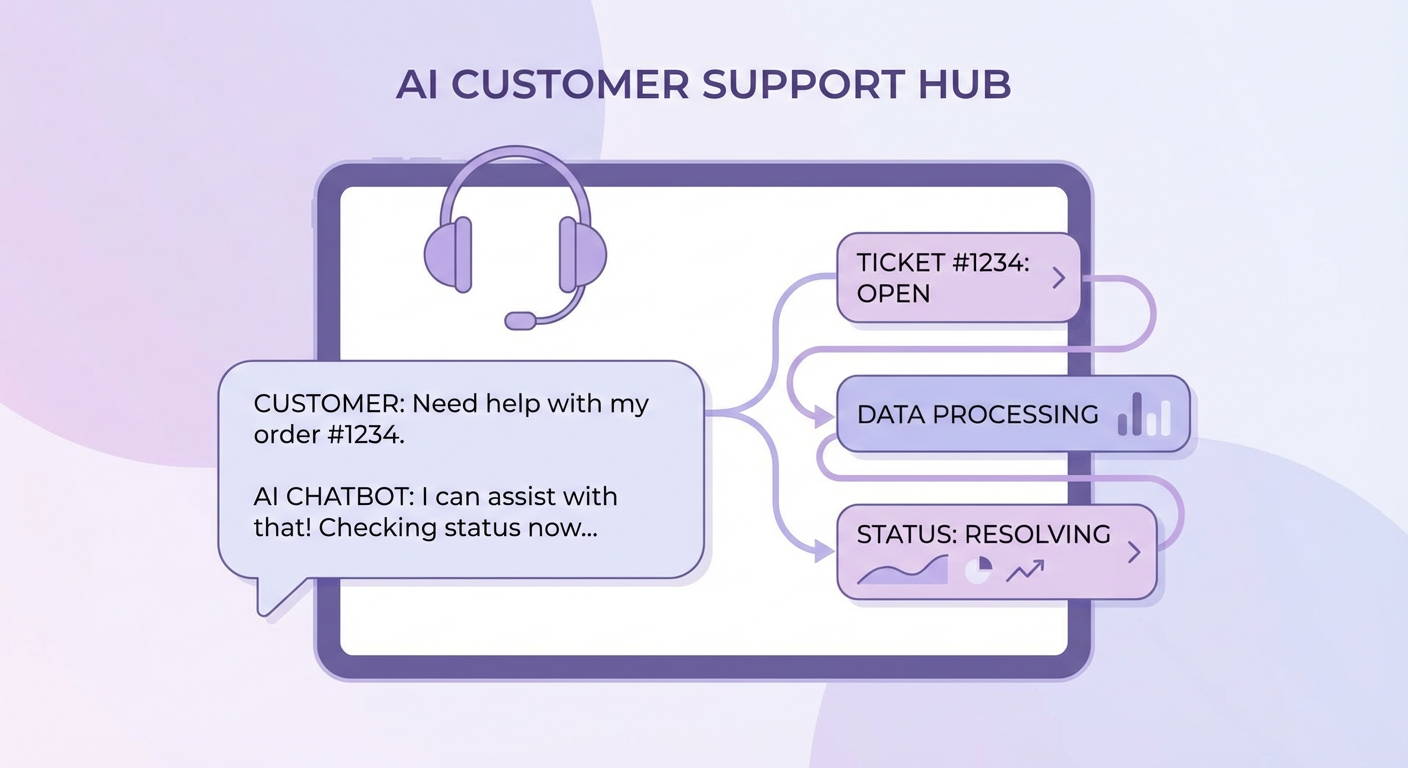
A Shopify brand I work with was paying $750 a month for Gorgias on the Advanced plan. They had three support agents using it full time. Gorgias gave them a shared inbox, macros, some basic auto-replies based on keyword matching, and integration with Shopify so reps could see order data in a sidebar. Useful stuff. The problem was that their agents were still spending most of their time doing the same thing they did before Gorgias: opening Shopify admin in a separate tab, searching for orders, copying tracking numbers, calculating refund amounts, and manually typing out responses.
Gorgias made it slightly faster. The order info was in a sidebar instead of a separate tab. But the reps were still doing the work. Reading the order, interpreting the customer's request, typing the response, clicking the refund button, confirming the amount. The helpdesk organized the queue. It didn't do the work.
That distinction matters a lot when you're paying $750 a month and your team is still drowning in tickets every Monday morning.
The Traditional Helpdesk Model
Helpdesks like Gorgias, Zendesk, Richpanel, and Reamaze all follow the same basic model. They give you a unified inbox where tickets from email, chat, social, and SMS all land in one place. They give you macros and templates so reps can respond faster. They give you some level of Shopify integration so order data is visible alongside the ticket. And they charge you based on ticket volume or seat count, usually both.
The pricing model tells you everything. Gorgias charges $300/mo for the Basic plan (300 tickets/mo included), $750/mo for Advanced (5,000 tickets/mo), and if you go above that, you're paying per ticket. Zendesk starts at $55/agent/month. Richpanel starts at $29/agent/month. These are tools for managing human work, and they're priced accordingly.
The limitation is that macros and templates only go so far. A macro can auto-fill "Hi {customer_name}, your order {order_number} shipped on {shipping_date}" if the data is already in the system. But most customer questions aren't that clean. "Hey, I ordered something last week and haven't gotten it yet" requires a lookup. "What's the difference between the two sizes?" requires reading the catalog. "I want to return the blue one but keep the red one" requires calculating a partial refund. Macros can't do any of that.
What's Actually Automatable
I've looked at support ticket data from about a dozen Shopify brands now, and the pattern is consistent. Here's what the ticket distribution looks like.
About 25-30% of tickets are order status inquiries. Where's my order, when will it ship, has it been delivered. These are pure data lookups. The answer is in Shopify's fulfillment records.
About 15-20% are product questions. Is this in stock, what's the difference between X and Y, does this come in a different color. The answer is in the product catalog.
About 15% are return and refund requests. I want to return this, I received a damaged item, can I get a refund. These require looking up the order, calculating the refund amount, and processing it. Every step is API-based.
About 10% are account and profile questions. Can you update my address, what's my order history, do I have any active subscriptions. These are customer profile lookups.
That's roughly 65% of your ticket volume. All of it is answerable from data that lives in Shopify. None of it requires human judgment. It requires human labor in the traditional helpdesk model, but the judgment component is zero. A trained agent follows the same steps every time.
The remaining 35% is where humans earn their keep. Complaints that need empathy. Policy exceptions that need manager approval. Custom requests that don't fit any template. Angry customers who need to feel heard before they'll accept a solution.
The Agent Approach
An AI agent doesn't replace your helpdesk. It replaces the manual work your reps do inside the helpdesk. The ticket still comes in through Gorgias or Zendesk or wherever. But instead of a rep opening the ticket, reading it, switching to Shopify admin, looking up the order, composing a reply, and hitting send, the agent does all of that in seconds.
For an order lookup and refund, the agent reads the customer's message, identifies the order (by number, email, or name), pulls the order details from Shopify, checks fulfillment status, and if the customer wants a refund, calculates the amount and processes it. The whole thing takes 10-15 seconds.
For a return and refund request, the agent identifies which line items the customer wants to return, checks the order to confirm those items were delivered, calculates the refund amount for those specific items, and processes it. Partial refunds, which take reps 5-10 minutes of careful clicking through Shopify's refund interface, take the agent the same 10-15 seconds as any other request.
The agent isn't replacing the helpdesk's inbox or routing or reporting. It's replacing the 4-7 minutes of manual work per ticket.
The Cost Math
Let's run the numbers on a mid-size Shopify store doing 100 tickets a day.
Gorgias Advanced plan: $750/month. Three support agents at $20/hour, 8 hours a day, 5 days a week: roughly $9,600/month in labor. Total support cost: about $10,350/month.
If 65% of those tickets are automatable and an agent handles them, you need your three agents to cover 35 tickets a day instead of 100. That's one agent's workload. You could drop to one agent and save $6,400/month in labor. Or you could keep all three agents and have them actually work on the hard tickets, which improves response time and customer satisfaction on the ones that matter.
Either way, the agent isn't $750/month. It's a fraction of that. And it doesn't charge you per ticket.
The hidden savings are in training costs. A new Gorgias rep needs 2-3 weeks to learn your product line, your return policy, your common ticket patterns. An agent needs a connection to your Shopify store and a prompt that describes your policies. You can update the policy on a Monday and the agent follows the new rules on Tuesday. No retraining, no team meetings, no "I forgot we changed the return window."
Why Use an Agent For This
The helpdesk market has been around for 15 years. Zendesk, Freshdesk, Intercom, and now the Shopify-specific ones like Gorgias and Richpanel. They've all been optimizing the same thing: making human reps slightly faster. Better UI, better macros, better routing, better analytics.
None of them eliminated the core bottleneck, which is that a human being has to read a ticket, understand it, look up data, compose a response, and send it. That takes 4-10 minutes regardless of how nice the UI is.
An agent eliminates that bottleneck for the majority of tickets. It reads the ticket, understands the intent, fetches the data, composes the response, and sends it. The hard part of support, the emotional labor, the judgment calls, the relationship building, stays with your team. The repetitive data work goes away.
I'm not saying cancel Gorgias tomorrow. If you like the inbox and the reporting, keep it. Use the agent alongside it. But if you're paying $750/month for a tool that still requires humans to do the actual work on every ticket, it's worth asking whether the money would be better spent on something that does the work itself.
Try These Agents
- Shopify Product Catalog Lookup -- Answer product questions from live catalog data
- Shopify Order Lookup & Refund -- Look up orders and process refunds in seconds
- Shopify Return & Refund Processor -- Handle partial returns and refund calculations automatically
- Shopify Customer 360 View -- Pull complete customer profiles with order history and lifetime value