
Stop Writing Follow-Up Emails. Let an Agent Build the Sequence.
Here's a number that changed how I think about cold email: 58% of our positive replies came from emails two through four in the sequence. Not the first email. Not the last Hail Mary at email seven. The middle of the sequence, where most teams write the laziest copy.
Kenji showed me the data last quarter. We'd been obsessing over first-touch emails — testing subject lines, agonizing over opening sentences, running A/B tests on personalization depth. Meanwhile, our follow-ups were templates. Literal templates. "Just bumping this to the top of your inbox." "Wanted to circle back on my previous email." "Did you get a chance to review this?"
Those follow-ups were performing despite themselves, purely because persistence works. Imagine what they'd do if they were actually good.
The problem: writing good follow-ups is boring. It's the least glamorous part of cold email. Writing the first email is creative. Writing follow-up number three for the fourth sequence variant targeting VP-level prospects at mid-market SaaS companies who haven't opened any prior emails — that's a slog. Kenji was spending about 12 hours a week writing sequence variants. Twelve hours of "how do I say the same thing differently for the fifth time."
We pointed an AI agent at our campaign builder workflow and let it handle sequence generation. The results were better than what Kenji was writing manually, and I say that knowing he'll read this article.
Why Follow-Ups Are Where Sequences Win or Die
There's a misconception that cold email is about the first impression. It isn't. Cold email is about controlled persistence. The first email introduces you. Follow-ups do the actual persuading.
The data supports this consistently. Our own numbers: the first email in our best-performing campaign had a 1.2% reply rate. Emails two through four, combined, had a 3.4% reply rate. The sequence as a whole converted at 4.6%.
But here's the catch: bad follow-ups actively hurt you. "Just following up" is not a follow-up. It's an admission that you have nothing new to say. Every email in a sequence needs to deliver new information, a different angle, or a different emotional register. Email one presents the problem. Email two presents social proof. Email three presents urgency. Email four presents an easy exit ("if this isn't relevant, no worries — can you point me to the right person?"). Each email should make sense on its own if the prospect didn't read the previous ones, because many prospects don't.
Writing sequences that do this well, across multiple campaigns with different ICPs, is genuinely difficult. Priya, who handles our financial services campaigns, told me she changes her follow-up sequences because she's tired of reading the same copy, not because the data says they're underperforming. Human writers optimize for their own boredom, not for performance.
The Manual Sequence-Building Process
Before agents, here's how Kenji built a new SmartLead campaign sequence.
He'd start with the ICP definition: who are we targeting, what do they care about, what problem are we solving. Then he'd write the first email, which usually went through three or four drafts. Good. That's where creative energy should go.
Then he'd write follow-up one. This was usually strong because the first email was still fresh in his mind and he had clear direction for an alternative angle.
Follow-up two got harder. He'd already used his best angles. Now he's reaching for something new — maybe a case study, maybe a different pain point, maybe a more casual tone. It takes longer. The quality is still decent but not as tight.
By follow-up three, the quality dropped noticeably. Kenji knew it. "I'm basically saying the same thing with different words and hoping they don't notice." The sentences got longer. The copy got vaguer. Generic phrases crept in.
Follow-up four and beyond? Template territory. "Checking in." "Touching base." "Wanted to make sure this didn't get buried." Copy that could have been written by anyone about anything.
Now multiply this by A/B variants. For a single campaign, Kenji might write two variants of the first email and two variants of each follow-up. That's ten pieces of copy for one five-step sequence. For five active campaigns, that's fifty pieces of copy. Every month. While also monitoring performance, adjusting targeting, and managing client expectations.
At some point Kenji started reusing follow-ups across campaigns. Same follow-up three for the fintech campaign and the healthcare campaign. The recipients were completely different people with completely different problems receiving the same generic "wanted to circle back." It performed accordingly.
What the Agent Builds
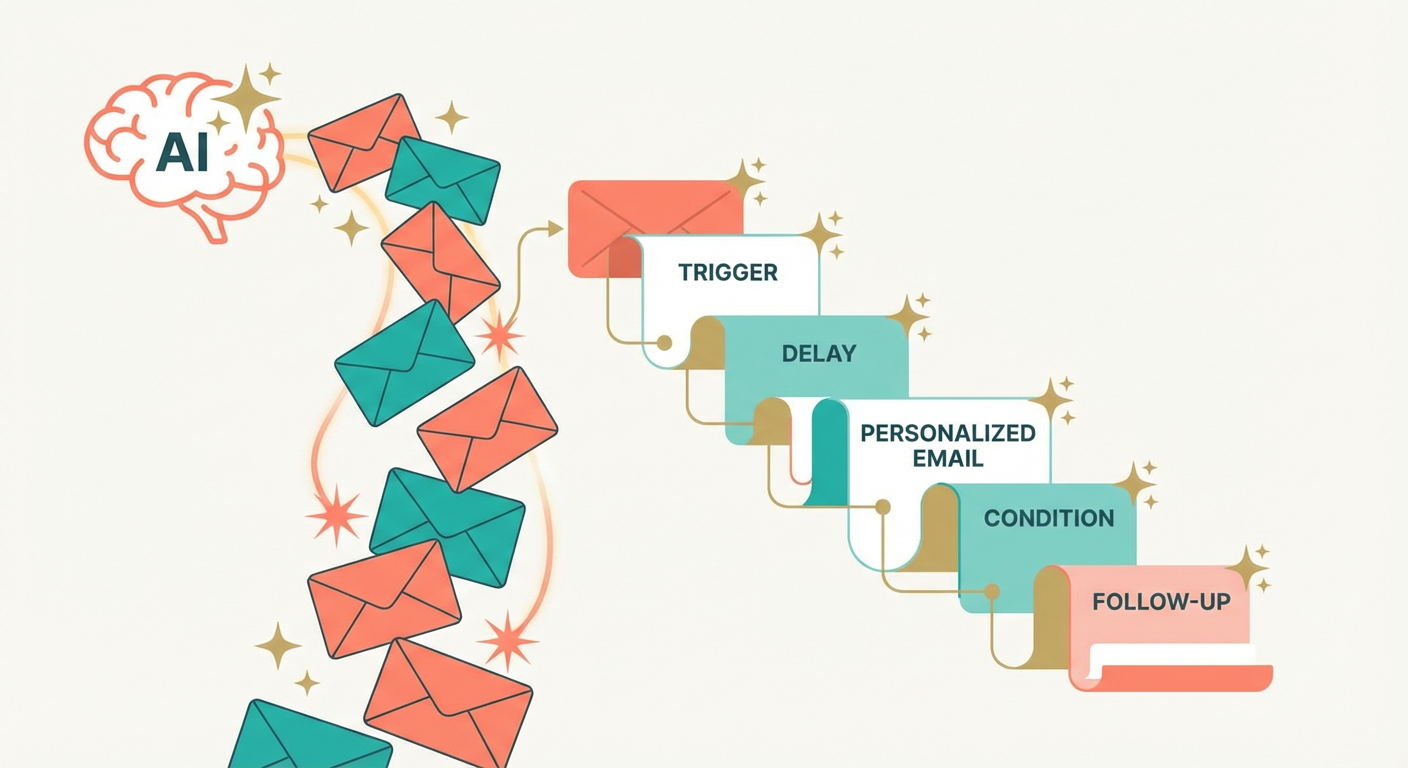
The campaign builder agent generates complete multi-step sequences from an ICP description and campaign goal. You tell it: VP of Engineering at Series B SaaS companies, 50-200 employees, pain point is developer productivity tooling. The agent produces a full sequence.
What surprised me was the structural variety. The agent doesn't just rephrase email one five times. It builds each email around a distinct strategy. Email one was a direct value proposition. Email two led with a specific metric from a similar company. Email three asked a question designed to provoke a response even from uninterested prospects. Email four was a breakup email that reframed the value prop from a different stakeholder's perspective. Each email worked independently. If a prospect only opened email three, it stood on its own.
The agent also generates A/B variants for each step. Not superficial variants like swapping a subject line word. Structural variants — one version leading with a question, the other leading with a statement. One version using a case study, the other using industry data. Meaningful differences that test real hypotheses about what this audience responds to.
Kenji reviewed the agent's first batch of sequences with visible skepticism. He marked up twelve changes across a five-email, two-variant sequence. Fair enough. The agent's first drafts weren't perfect. But those twelve changes took him about 20 minutes. Writing the same sequence from scratch would have taken three hours. That's an 89% reduction in time, and the quality — Kenji's word, not mine — was "85% of the way there before I touched it."
Performance Monitoring: The Part Nobody Talks About
Writing the sequence is half the job. The other half is figuring out which variants win and iterating.
In the manual world, Kenji would check SmartLead analytics every few days, compare variant A against variant B, and make a judgment call about which was performing better. "Variant A has a 3.1% reply rate and Variant B has a 2.8% reply rate" — is that a real difference or noise? With 200 sends per variant, it might be noise. With 2,000, it's probably real. Kenji isn't a statistician. He went with his gut, and his gut was right maybe 70% of the time.
The agent monitors variant performance continuously and recommends winners when the data reaches statistical confidence. "Variant A of email 3 has a reply rate of 4.2% vs. Variant B at 2.1% with p-value 0.03 after 1,400 total sends. Recommend promoting Variant A." It takes the gut feel out and replaces it with math.
It also suggests new variants to test based on what's working. If the winning variant of email two used a question opener, the agent might propose a new variant of email three that also uses a question opener, testing whether the pattern holds across sequence steps. Kenji never would have thought to test that systematically. He was too busy writing copy to analyze patterns across campaigns.
The Actual Results
In the three months since deploying the agent, our average reply rate across all campaigns increased from 3.8% to 5.4%. That's a 42% improvement. I can't attribute all of it to the agent — Kenji's also gotten better at the editing and direction-setting parts of his job now that he's not drowning in first drafts. But the improvement in follow-up performance specifically is stark. Follow-up emails two through four went from a combined 3.4% reply rate to 5.1%.
Kenji's time on sequence creation dropped from 12 hours per week to about 3 hours. Those 3 hours are spent reviewing agent-generated sequences, making edits, and setting campaign direction. He describes his job now as "creative director" rather than "copywriter." The agent writes. He edits and decides.
The number of active A/B tests running at any time went from an average of 4 to 14. We're testing more hypotheses because the cost of creating variants dropped to almost zero. More tests means faster learning. Faster learning means better campaigns.
Diana, who handles reporting, noticed something unexpected in the data. Our unsubscribe rate on follow-up emails dropped from 1.8% to 0.9%. The agent-written follow-ups were less annoying. They delivered new information instead of "just checking in," which meant fewer people felt compelled to opt out. Lower unsubscribes means a larger active audience, which compounds over time.
The Part Humans Still Own
The agent doesn't know your voice. It doesn't know that your CEO hates exclamation points, or that your brand never uses the word "synergy," or that your best clients respond to dry humor. It writes competent cold email. Kenji turns it into cold email that sounds like it came from your company.
What the agent eliminates is the grind. The four hours of writing follow-up number three for the eighth time this month. The copy that gets worse because the writer is exhausted. The A/B tests that don't happen because creating variants takes too long. The performance analysis that happens by gut instead of by data.
Kenji doesn't miss writing follow-ups. He told me: "I used to think writing every email myself was the job. It turns out the job is making sure every email is good. Those are different things."
Try These Agents
- SmartLead Apollo Campaign Builder -- Generate full multi-step sequences with A/B variants from Apollo prospect lists and ICP definitions
- SmartLead Campaign Performance Tracker -- Monitor variant performance across campaigns with statistical confidence tracking
- SmartLead Campaign Activator -- Launch optimized sequences on schedule with automatic warmup management
- SmartLead Lead Cleanup Manager -- Ensure lead quality before sequences start sending to protect deliverability