
Automate Shopify Product Questions with AI
Last week I pulled the ticket logs from a DTC skincare brand running on Shopify. They average 140 support tickets a day. I tagged each one by type. Fifty-eight of them, 41%, were product questions. "Is the retinol serum in stock?" "What's the difference between the daily moisturizer and the repair cream?" "Does this come in a travel size?" "Can I use this if I have sensitive skin?"
Every single answer was already in Shopify. Product descriptions, variant details, inventory counts, metafields with ingredient lists. The information existed. Customers just couldn't find it, or didn't bother looking. They emailed support instead, and a rep burned four minutes per ticket opening Shopify admin, hunting down the product, reading the description, checking stock levels, and writing a reply.
Do the math: 58 tickets at four minutes each. That's 232 minutes, almost four hours of a support rep's day spent on questions their own catalog already answered.
The Product Question Problem
The thing about product questions is that they feel like they need a human. The customer is asking something specific. "Will this moisturizer work with my retinol routine?" feels like it requires expertise. And sometimes it does. But most of the time, the answer is sitting in your product description or a metafield your team already filled out.
The breakdown usually looks like this. About half of product questions are availability checks. Is it in stock, when will it be back, do you have it in a specific size or color. These are pure data lookups. The answer is a number in your inventory system.
Another quarter are comparison questions. What's the difference between product A and product B. Your product pages have the answer, but customers aren't going to open two browser tabs and read paragraphs of marketing copy side by side. They'd rather just ask.
The remaining quarter are usage questions. Is this compatible with X, how do I use this, what are the ingredients. These answers are usually in metafields, product tags, or the long description that nobody scrolls down to read.
Your Shopify store has all of this data already. The problem isn't missing information. It's that nobody has built a fast path from "customer asks a question" to "here's the answer from your catalog" without a human in the middle.
How an AI Agent Handles Product Lookups
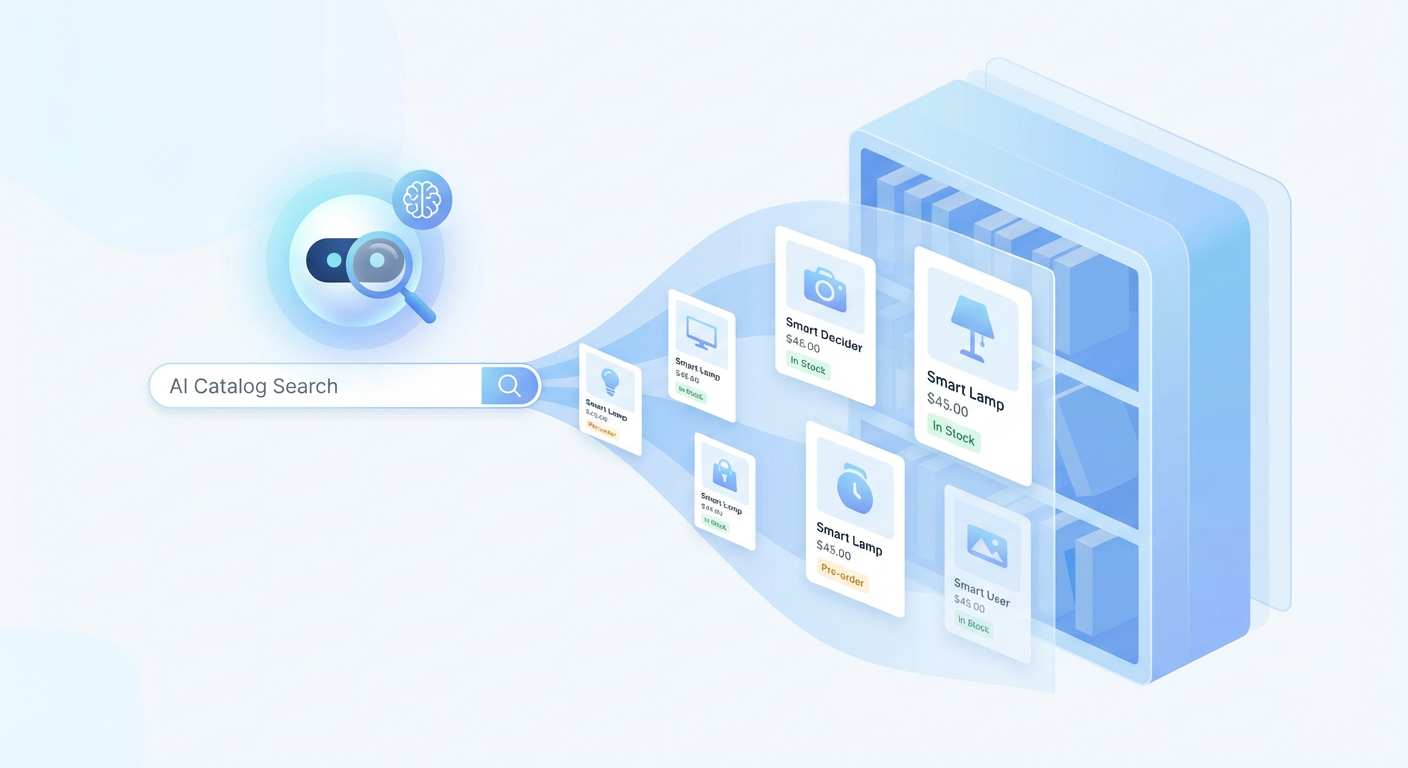
A Shopify product catalog lookup agent works by connecting directly to your Shopify Admin API and searching your product catalog in real time. When a customer asks "do you have the vitamin C serum in stock," the agent doesn't search a cached FAQ page from three months ago. It hits your live product data.
Here's what the workflow looks like in practice. Customer writes in with a question. The agent figures out which product they're talking about and runs a search across your Shopify catalog, matching on titles, product types, tags, whatever fits. Then it grabs the full product record: every variant, every price point, current inventory, the whole description. And it writes back in plain language.
Got a comparison question? The agent grabs both products and gives you a side-by-side breakdown of what's different. Availability question? It checks inventory across every variant and location. Ingredients or usage? It reads your metafields and product tags, the stuff customers never scroll down far enough to find.
What used to take a rep four minutes now takes about eight seconds. And the answers are more accurate because the agent is reading current data from Shopify, not working from memory across 200 SKUs.
What Changes for Your Support Team
When you remove product questions from the queue, the math on your support operation changes. If 40% of your tickets are product questions and the agent handles 80% of those correctly without human involvement, you just freed up a third of your support capacity.
That doesn't mean you fire a third of your team. It means your reps get to work on the tickets where a human actually matters. The customer who's upset about a late shipment and needs somebody who gives a damn on the other end of the chat. The wholesale buyer with a custom pricing request. The return that involves a judgment call about store policy. Those tickets get faster responses because your queue isn't clogged with "is this in stock."
I talked to a brand doing about $8M in annual revenue on Shopify. Four-person support team. After they set up an agent for product questions, their average first-response time dropped from 2.4 hours to 38 minutes. They didn't reduce headcount. They just stopped hemorrhaging time on lookups.
Consistency changes too. Your newest hire doesn't know the difference between your two retinol products, so they have to look it up, maybe ask a colleague, maybe give a vague answer. The agent never has that problem. It reads the catalog directly, every time, on day one. No ramp-up, no "I think this one has hyaluronic acid but let me double check."
Combining Product Lookup with Other Workflows
Product questions rarely exist in isolation. A customer who asks "is this in stock" often follows up with "can you check on my last order too" or "I want to return the one I bought last month." If your agent can only answer product questions and nothing else, you've built a dead end.
The better approach is to pair the product catalog agent with a customer 360 view that can pull the customer's profile and order history, and an order lookup and refund agent that can check fulfillment status and process returns. Now you have an agent that handles the full support conversation, not just one type of question.
A typical flow looks like this. Customer emails: "Hey, I ordered the daily moisturizer last week and it hasn't arrived yet. Also, do you still carry the overnight repair cream? I want to add it to my next order." One email, two questions. The agent checks the order status, pulls the tracking info, then searches the catalog for the overnight repair cream, checks inventory, and responds with both answers in one message. No handoffs, no "let me check with someone and get back to you."
Why Use an Agent For This
You might be thinking that a good FAQ page or a search bar would solve this. And for some stores, it does. If you have 30 products and clear descriptions, most customers can find what they need on their own.
But once you cross 100 SKUs, the product catalog gets hard to navigate. Customers don't know your product naming conventions. They search "anti-aging cream" and your product is called "renewal night treatment." They search "travel size" and your variant is labeled "30ml." The gap between how customers describe what they want and how your catalog is structured is where product questions come from.
An agent closes that gap because it reads natural language the way your best rep would. Customer says "anti-aging cream," the agent reads your product description that mentions "formulated to reduce visible signs of aging" and makes the connection. Customer asks for "travel size," the agent finds the 30ml variant. It's not doing keyword matching. It's reading your product data and understanding what the customer actually means.
And here's the thing about product catalogs: they change constantly. New products, updated descriptions, price changes, things going out of stock. A FAQ page goes stale the week you publish it. The agent hits live Shopify data on every single query, so it's never working from outdated information.
Try These Agents
- Shopify Product Catalog Lookup -- Search your catalog in real time and answer product questions instantly
- Shopify Customer 360 View -- Pull a complete customer profile with order history and lifetime value
- Shopify Order Lookup & Refund -- Check order status, fulfillment, and process refunds in one conversation