
Our Shopify Store's GA4 Reports Used to Take All Friday. Now They Take Five Minutes.
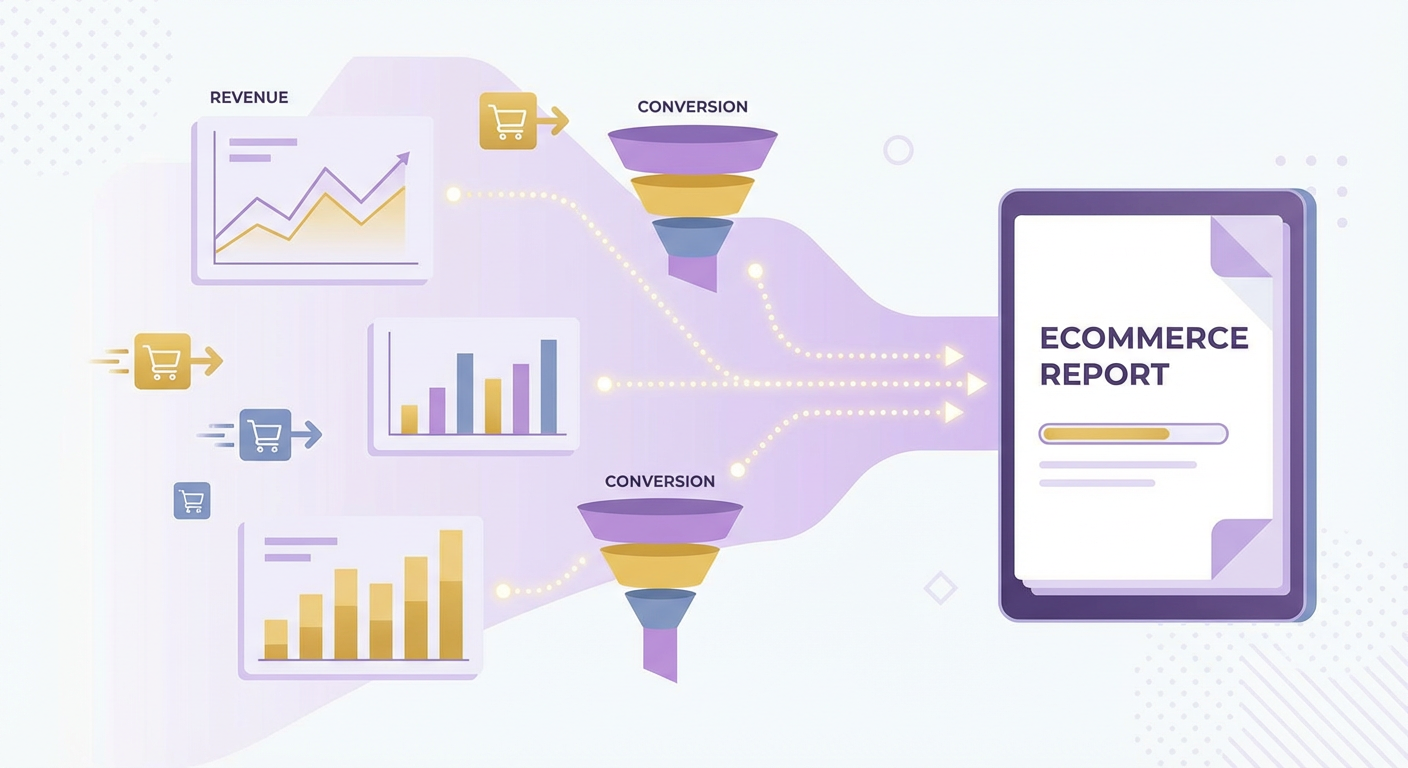
Priya ran ecommerce analytics for our Shopify store and she had a recurring calendar block every Friday from 1 PM to 5 PM labeled "weekly numbers." Four hours. Every Friday. I assumed it was a meeting. It was not a meeting. It was Priya, alone, pulling data from GA4, Shopify admin, and Google Ads, pasting everything into a master spreadsheet, and building a weekly ecommerce performance summary for the leadership team.
The spreadsheet had 14 columns. Revenue by channel. Conversion rate by device. Average order value trends. Product category performance. Return on ad spend by campaign. Cart abandonment rate. Each number came from a different report in a different tool, and none of the tools agreed on the definitions. Shopify said Tuesday's revenue was $47,200. GA4 said $44,800. The discrepancy was attribution windows, but explaining that to the CEO every week got old fast.
"I spend more time explaining why the numbers don't match than I spend on anything useful," Priya told me in January. By March, she had automated the entire thing.
The Friday Afternoon Grind
The process, step by step, looked like this. Priya would open GA4, navigate to the ecommerce reports, and pull revenue and transaction counts by source/medium for the past seven days. Then she would open a separate GA4 exploration to get conversion funnel data, because the standard reports do not show funnel drop-off rates by channel. That exploration took about 15 minutes to configure each time because GA4 explorations do not save filter states reliably.
Next she would open Shopify admin for product-level performance. Which SKUs sold the most units. Which products had the highest return rates. Which collections drove the most revenue. GA4 has some of this data through enhanced ecommerce tracking, but the product names in GA4 rarely matched Shopify's product names exactly. Priya maintained a manual mapping spreadsheet for this. Forty-seven products. Updated whenever the catalog changed, which was roughly twice a month.
Then Google Ads for the paid media numbers. Click-through rates, cost per click, cost per acquisition. She would cross-reference the Ads data with GA4 conversion data to calculate true ROAS, because Google Ads' built-in ROAS metric uses its own conversion tracking, which diverged from GA4's numbers by anywhere from 8% to 25% depending on the campaign.
The last hour was formatting. Color-coding cells that moved more than 10% from last week. Writing a three-paragraph summary at the top of the spreadsheet. Highlighting the two or three things the leadership team should actually pay attention to. Adding footnotes explaining data discrepancies.
Four hours. Every week. Fifty-two weeks a year. That is 208 hours annually on a single recurring report.
What Broke the Cycle
Priya tried Looker Studio first. She built a dashboard that connected to both GA4 and Google Ads. It looked good. The charts were clean. But the dashboard could not do the cross-source calculations she needed. ROAS based on GA4 conversions instead of Google Ads conversions required a custom metric that Looker Studio could not compute across data sources. Product-level analysis required a Shopify data connector that cost $300 per month and broke every time Shopify updated their API.
She also tried a Supermetrics pull into Google Sheets. It worked for getting raw data out of GA4 and Ads into one place, but the transformation step was still manual. She had sheets full of raw API output and still spent 90 minutes formatting, calculating derived metrics, and writing the summary.
The thing that actually worked was pointing an AI agent at all three data sources. The GA4 Ecommerce Performance Tracker pulls ecommerce metrics from GA4, compares them to the prior period, and generates a formatted summary with the specific callouts an ecommerce team actually cares about. Revenue by channel, not just total revenue. Conversion rate by device, not just overall. Product performance ranked by contribution margin, not just units sold.
The first time Priya ran it, she compared the agent's output to her hand-built spreadsheet from the previous Friday. The numbers matched within 1.5%, which was closer than GA4 and Shopify usually matched each other. The discrepancy was a timezone difference in how the agent handled the date boundary. She adjusted the configuration, ran it again, and the numbers matched.
Revenue Attribution Without the Headaches
The revenue attribution problem deserves its own discussion because it is the thing that eats the most time in ecommerce analytics.
GA4 uses data-driven attribution by default. That means it assigns conversion credit across touchpoints using a machine learning model. This is more sophisticated than last-click attribution, but it makes the numbers harder to explain. When the CEO asks "how much revenue did email drive this week?" and the answer is "well, email was a contributing touchpoint in $23,000 worth of conversions, but the primary touchpoint was organic search in $14,000 of those, and direct in $6,000, and..." you lose the room.
Priya's manual process was to pull both last-click and data-driven attribution and present them side by side, which meant running the same report twice with different attribution settings. In the agent, this is a single request. Pull revenue by channel with data-driven attribution, then pull it again with last-click, and present both. The agent also adds the delta between the two, so the leadership team can see which channels benefit most from multi-touch credit.
Tomás, who manages our paid campaigns, said this was the single most useful change. "I used to argue with the CEO about whether paid social was working because GA4's default attribution gave it $12,000 in revenue but last-click gave it $4,000. Now both numbers are right there with context. The argument went away."
Product Performance Tracking
The second area where the agent saved Priya real time was product-level analysis. Her old process involved exporting product data from both Shopify and GA4, fuzzy-matching product names between the two systems, and combining the results. Shopify had accurate revenue and return data. GA4 had traffic and engagement data for product pages. Neither gave the full picture alone.
The agent handles the matching automatically. It pulls product page metrics from GA4 (views, add-to-cart rate, purchase completion rate) and combines them with the revenue data. The output includes a product performance table sorted by whatever metric Priya specifies. Usually she sorts by add-to-cart-to-purchase conversion, because that identifies products where people show interest but do not buy. Those are the products with pricing problems or checkout friction.
One week the agent flagged a product with a 47% add-to-cart rate but only a 3% purchase rate. Priya dug in and found that the product's shipping cost was not displayed until the final checkout step. Shoppers were adding it to cart, seeing the $18 shipping fee at checkout, and bailing. The team added shipping cost to the product page. Purchase rate went to 11% within two weeks. That insight was technically available in the data before the agent, but nobody had time to look at individual product funnels across 47 SKUs every week.
What the Leadership Team Actually Sees Now
The Friday report now arrives at 8 AM. Nobody builds it. The leadership team opens Slack and finds a structured summary: total revenue versus last week and the same week last year. Top three channels by revenue with attribution comparison. Three products trending up, two trending down, with reasons. Campaign ROAS using GA4 conversions instead of Google Ads' inflated numbers. Cart abandonment rate with a comparison to the 30-day average.
Below the summary, there is a link to the full data in a Google Sheet for anyone who wants to dig deeper. Most weeks, nobody clicks it. The summary is enough.
Priya's Friday afternoons are now free. She uses them for the kind of analysis she never had time for before: cohort studies on repeat purchase behavior, seasonal trend modeling, landing page optimization testing. The work she was hired to do, instead of the report assembly she ended up doing.
Elena, our GM, put it simply: "We were paying an analyst's salary for someone to copy and paste numbers between three tabs every Friday. That was on us, not on Priya."
Try These Agents
- GA4 Ecommerce Performance Tracker -- Pull revenue attribution, product performance, and conversion funnel data from GA4 automatically
- GA4 Channel Attribution Analyzer -- Compare multi-touch and last-click attribution across channels to settle the credit debate
- GA4 Weekly Traffic Report -- Automated weekly traffic summary with trends and week-over-week comparisons
- GA4 Content Performance Auditor -- Identify which content pages drive ecommerce traffic and conversions