
I Tried to Automate PPC for 18 Months. Here Is What Actually Worked
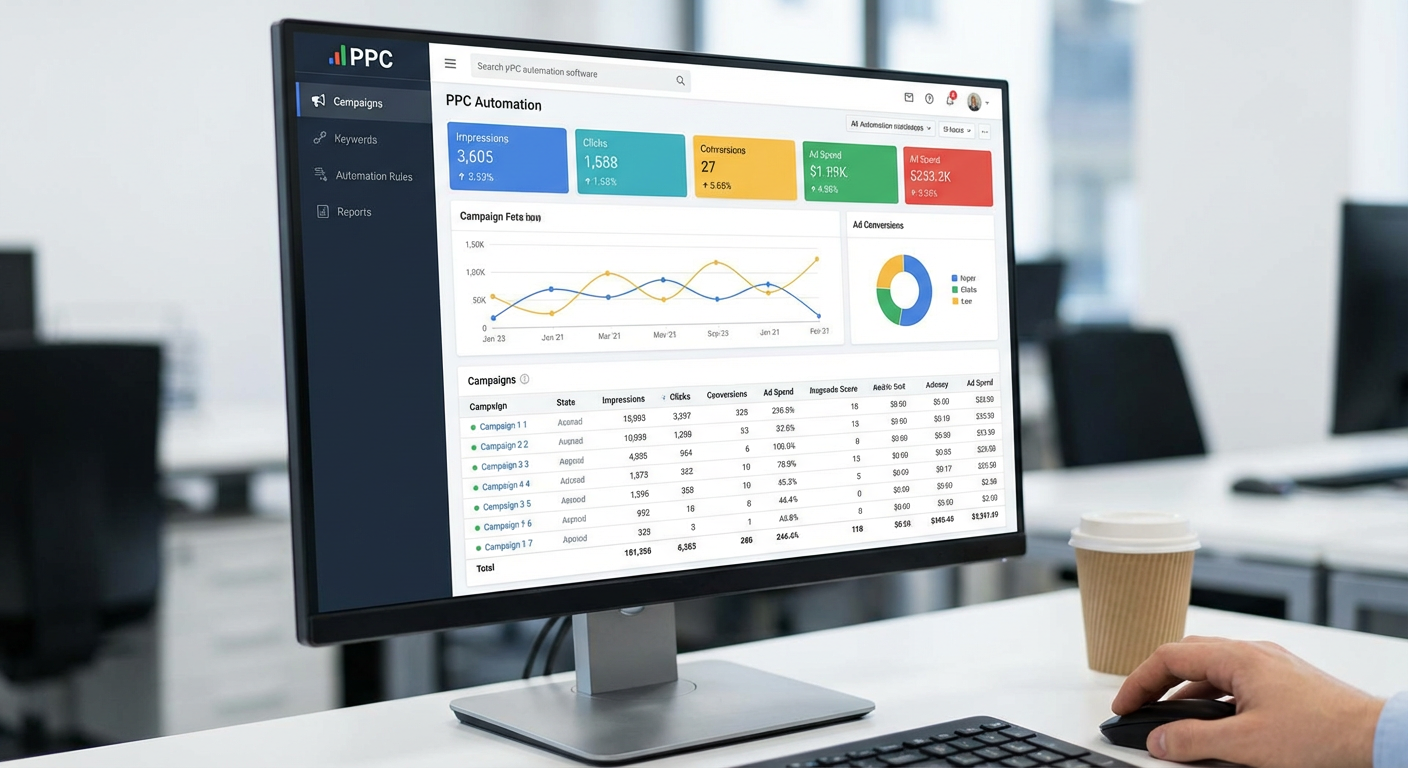
Diana sent me a screenshot last March that I still have saved. It was a calendar invite titled "PPC Weekly Reporting" that recurred every Monday at 9am. She'd added it to her calendar 14 months earlier. In that time, she'd spent roughly 220 hours pulling campaign data, calculating week-over-week changes, writing summaries, and posting them to Slack. Two hundred twenty hours. That's more than five full work weeks spent on a task that was exactly the same every time, just with different numbers.
That screenshot was the catalyst for an 18-month project to automate every part of PPC management we could. Bid management, budget pacing, reporting, alerting, keyword optimization. We tried automating all of it. Some parts automated cleanly. Others didn't. And the difference between what works and what doesn't taught me more about PPC automation software than any product demo ever could.
The Four Layers of PPC Automation
PPC management breaks down into four distinct activities, and each one automates differently. I learned this the hard way by trying to use one tool for everything and failing.
The first layer is monitoring. Watching for things that go wrong. CPA spikes, budget exhaustion, conversion drops, quality score declines. This is detection. Something bad happened and you need to know about it.
The second layer is reporting. Compiling performance data on a schedule, comparing periods, and summarizing what happened. This is informational. Nothing went wrong necessarily, but stakeholders need to see the numbers.
The third layer is optimization. Making changes to improve performance. Adjusting bids, pausing underperformers, adding negative keywords, restructuring ad groups. This is action-oriented. You're changing the account based on data.
The fourth layer is strategy. Deciding what campaigns to run, what audiences to target, what messaging to test, how to allocate budget across channels. This is judgment. It requires understanding of the business, the competition, and the market.
Here's what I found after 18 months: layers one and two automate well. Layer three partially automates. Layer four doesn't automate at all. Most ppc automation software tries to sell you on automating all four and delivers on maybe one and a half.
Monitoring: The Easiest Win
Automated monitoring was the first thing we set up and the most immediately valuable. Before automation, our monitoring process was Tomás opening Google Ads every morning, scanning the dashboard for anything weird, and saying "looks fine" in Slack. He's a good marketer, but "scanning the dashboard" meant he was checking maybe 6-8 top-level metrics across our main campaigns. He wasn't checking every ad group. He wasn't looking at keyword-level quality scores. He wasn't reviewing search term reports.
We set up a campaign monitoring agent that runs every 4 hours and checks the things a human doesn't have time to check. CPA by ad group compared to trailing averages. Budget pacing by hour of day. Keywords that suddenly started spending with zero conversions. Search terms that don't match the keyword intent.
In the first week, it caught something Tomás had missed for three days: a campaign that exhausted its daily budget by 11am every day because a single keyword was getting aggressive mobile bid adjustments. The campaign was dark for the most expensive 5 hours of every workday. Fixing that one issue recovered about $1,800/month in wasted opportunity.
The monitoring agent also posts to Slack instead of requiring someone to log into a dashboard. This matters more than it sounds like it should. Dashboards require intent. You have to decide to go check them. Slack messages interrupt you, which is annoying for most things but exactly right for "your campaign just spent $200 in the last hour with zero conversions."
Reporting: Harder Than It Looks
Automated reporting was the second thing we tackled. Diana's 220-hour Monday ritual was the obvious target. A ppc automation tool that can pull data, calculate deltas, and write a summary should be straightforward, right?
It is straightforward for simple reports. Campaign-level metrics, week-over-week comparisons, top performers, worst performers. An agent pulls the data, formats a summary, and posts to Slack. We got Diana's Monday report automated within a week, and the quality was actually better than the manual version because the agent checked every campaign and every ad group instead of the top 10 that Diana had time for.
Where reporting gets complicated is when different stakeholders want different things. The marketing team wants keyword-level detail. The VP wants pipeline numbers tied to ad spend. Finance wants monthly budget tracking with forecasts. Each of these is a different report from the same data, requiring different queries and different formatting.
We ended up with three separate reporting agents: a weekly tactical report for the marketing team, a monthly executive summary for leadership, and a daily budget pacing report that logs to Google Sheets for finance. Setting up three reports took longer than setting up one, but each audience gets what they actually need instead of a compromise report that serves nobody well.
The daily pacing report was Anya's idea. She'd been tracking daily spend in a spreadsheet manually, adding a row each day and calculating the projected month-end spend. The agent does this automatically, and it logs historical data so we can see pacing trends over time. We've used the historical data twice to justify budget increases, which is a use case I didn't anticipate when we built it.
Optimization: Where It Gets Tricky
Bid management, keyword optimization, ad group restructuring, negative keyword management. This is the layer where most ppc automation software makes big promises and delivers mixed results.
Google's Smart Bidding handles the bid management layer reasonably well for most campaigns. Target CPA and Target ROAS bidding work. They're not perfect, but they're good enough that manual bid management is rarely worth the effort for individual keywords. We let Smart Bidding handle bids on most campaigns and only override it for brand terms and a few high-value keywords where we want direct control.
The optimization work that still matters is everything around the bids. Which keywords should be running at all? Which ad groups have too many keywords in them? Which search terms should be added as negatives? Where are quality score problems costing us extra per click?
This is where we found the most value from AI agents. A weekly ad group optimization pass reviews every ad group and recommends structural changes. Things like: "Ad group 'Enterprise Features' has 34 keywords, 8 of which have zero impressions in the last 30 days and 6 of which have quality scores below 5. Recommend removing the zero-impression keywords and breaking the low-quality-score keywords into a separate ad group with more specific ad copy."
That recommendation isn't a number. It's a structural suggestion based on a pattern in the data. The agent identifies the bloated ad group, diagnoses why it's underperforming (too many keywords diluting relevance), and suggests a specific fix. A human still decides whether to do it. But the analysis that surfaces the recommendation would take 45 minutes per ad group to do manually, and we have 60+ ad groups.
Strategy: Still Human Territory
I've seen ppc automation software marketing that implies the tool will handle your entire PPC strategy. Pick your budget, set your goals, and the software will figure out the rest. That hasn't been my experience.
Strategy decisions require context that no automation tool has. Should we bid on competitor brand terms? That depends on our brand position and how aggressive we want to be. Should we expand into Display Network? Depends on our creative assets and whether we can handle the lower intent traffic. Should we run experiments with Performance Max? Depends on our conversion tracking maturity and whether we trust Google's black box.
These aren't data questions. They're judgment calls that depend on business context, competitive dynamics, and risk tolerance. No ppc automation software handles them, and you should be skeptical of any that claims to.
What automation does for strategy is give you better inputs. When your monitoring, reporting, and optimization are automated, you have clearer data to make strategic decisions with. You know exactly which campaigns are working, which keywords are converting, and where your money is going. The strategy is still yours. The data is just cleaner.
What 18 Months Taught Me
If I had to summarize 18 months of experimenting with PPC automation, it would be this: automate the layers in order. Start with monitoring because catching problems early is the highest-ROI automation. Then automate reporting because it frees up the most human time. Then automate the repetitive parts of optimization, specifically the analysis that identifies what to change, even if you keep the decision to change it in human hands. Don't try to automate strategy.
The tools matter less than the layer. Google's native rules work for basic monitoring. Agents work better for monitoring that requires explanation. Spreadsheet exports work for basic reporting. Agents work better for reporting that requires synthesis. The pattern is consistent: the more a task requires reading data and forming an opinion about it, the better an agent handles it compared to a traditional rule-based tool.
Diana doesn't have that Monday calendar invite anymore. She deleted it two months into the automation project and nobody noticed, which is the highest compliment you can pay a piece of ppc automation software. The work still gets done. It just doesn't require a human to do it.
Try These Agents
- Google Ads Campaign Monitor -- Real-time monitoring with Slack alerts for CPA spikes, budget issues, and wasted spend
- Google Ads Ad Group Optimizer -- Weekly ad group analysis with keyword and structure recommendations
- Google Ads Weekly Performance Report -- Full weekly digest with campaign metrics and trend analysis
- Google Ads Spend Tracker -- Daily budget pacing with Google Sheets logging and month-end projections