
How an AI Chatbot Handles Shopify Returns End-to-End
I pulled our support ticket data last month and sorted by category. Returns and refund requests were 34% of total volume. Not the plurality. The majority of the top category. The next closest was order status inquiries at 22%.
Every return ticket looked the same. Customer wants to return something. Rep asks for the order number. Rep opens Shopify, hunts down the order, checks when it was placed, eyeballs whether it's inside the 30-day return window, makes sure it's not a final-sale item, does the refund math (was shipping included? is there a restocking fee?), processes the refund, confirms it actually went through, and emails the customer confirmation plus return shipping instructions. I timed it across our team. Eight minutes, average.
Multiply that by 40-50 return tickets on a busy day and you're looking at roughly 6 hours of labor. Same workflow, every ticket, every day. There's no creativity involved. Is the order within the window? Is the item returnable? What's the refund amount? Lookups and calculations, not judgment calls.
What the Return Workflow Actually Looks Like
Let me walk through what actually happens when a customer asks our chatbot for a return, because the details are where this gets interesting. When people hear "AI chatbot handles returns" they picture one of two things: a useless bot that immediately says "let me transfer you to a human," or some rogue system handing out refunds with zero oversight. We built something in between.
Here's how our return and refund processing agent works in practice.
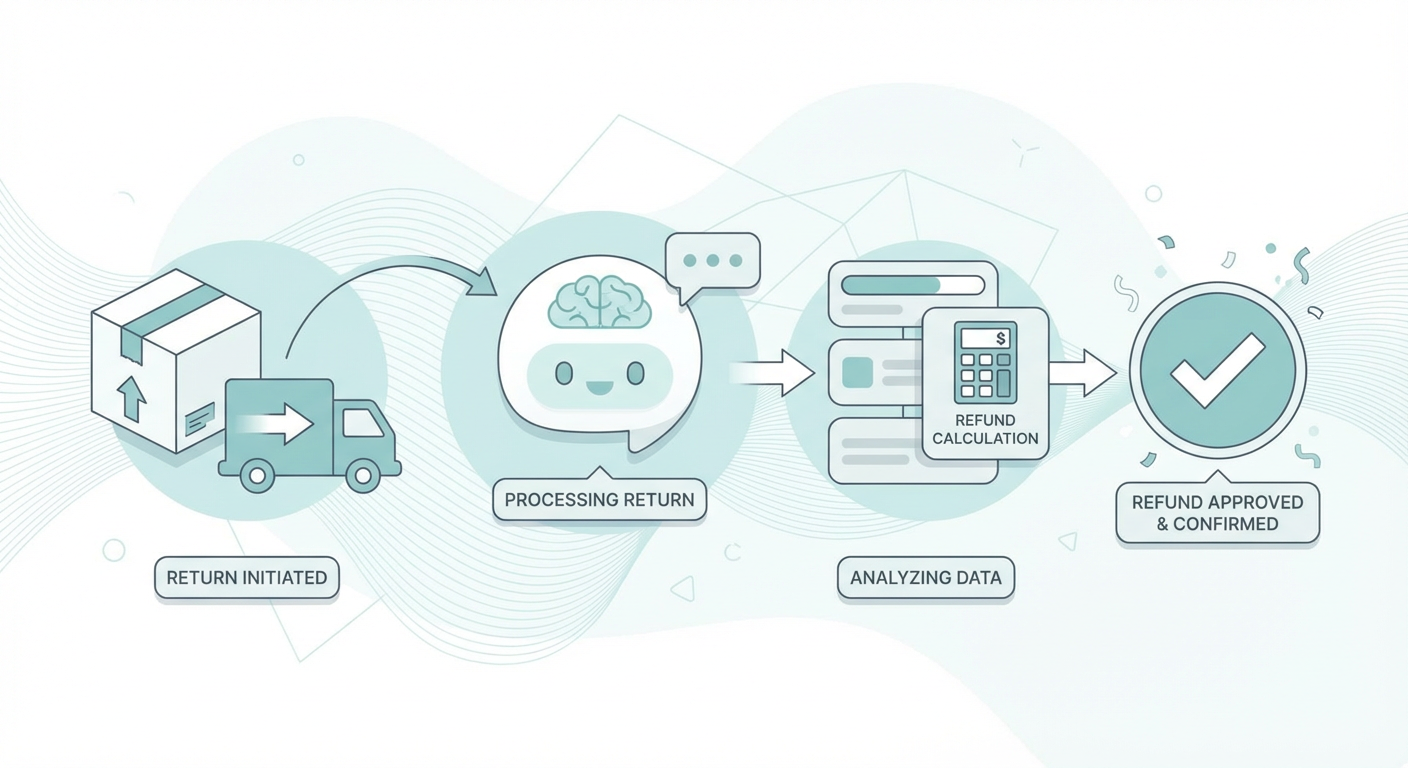
The customer gives us an order number, or their email, or sometimes just "I'm Sarah, I want to return something." The agent searches Shopify, finds the order, and if there are multiple matches (Sarah has bought from us six times), it asks which order the return is for. That alone skips the whole "open Shopify admin and search" step.
Next: the return window. The agent checks the order date against our 30-day policy. Placed 22 days ago? Eligible. Placed 45 days ago? The agent tells the customer straight up, no hedging. Reps sometimes miscounted the days, especially on orders placed near the end of a month. The agent doesn't have that problem.
Then item eligibility. We have final-sale products. We have categories with different rules. The agent checks each line item against the policy and tells the customer what's returnable and what isn't. Three items in the order, two eligible? It handles the partial return without getting confused.
Now the refund calculation, which is honestly where manual processing falls apart most often. Partial refunds on multi-item orders with shipping deductions, restocking fees, and tax adjustments are genuinely hard to get right in your head. The agent calls Shopify's own refund calculation API and shows the customer the breakdown before anything happens. "Item A: $45.00. Item B: $32.00. Minus $7.95 restocking fee. Total refund: $69.05. Want to go ahead?"
Last step: process it or kick it upstairs. We set a $100 threshold. Anything under that, the agent processes the refund on the spot, done. Over $100, the agent bundles the whole case (order details, eligibility results, calculated refund amount) and drops it in front of a rep for a single-click approval. The rep doesn't have to re-research the order or redo the calculation. Everything's already there, they just say yes or no.
The Guardrails That Make It Safe
I've had this conversation probably 30 times now: "But what if it refunds something it shouldn't?" Fair question. I had the same worry before we turned it on. Here's what we put in place.
Dollar thresholds. Set a maximum refund amount the agent can process without human approval. We started at $50 and raised it to $100 after two weeks of zero errors. Some teams start at $0 (meaning every refund gets human approval) and gradually increase as they build confidence. Even at $0 the agent still saves time because it does all the research and calculation. The rep just clicks "approve."
Policy enforcement. The return policy is encoded in the agent's instructions. Return window, eligible categories, exclusions, restocking fees. The agent can't override these rules. If a customer says "but I've been a loyal customer for years, can you make an exception?" the agent recognizes this as a policy exception and routes it to a human. It doesn't try to be creative.
Refund calculation verification. The agent uses Shopify's own refund calculation endpoint, not its own math. This means the refund amount matches exactly what Shopify would show if a rep processed it manually. No rounding errors, no missed tax adjustments, no forgotten shipping deductions.
Audit trail. Every action the agent takes is logged. Order looked up, return window checked, eligibility verified, refund calculated, refund processed (or escalated). If something goes wrong, you can trace exactly what happened and why. We review the logs weekly for the first month of any new automation. After that, monthly.
What This Looks Like for the Customer
From the customer's perspective, the experience is faster and more consistent than a human rep. They send a message saying they want to return something. Within seconds, the agent has their order pulled up and is asking which items they want to return. The eligibility check and refund calculation happen in the same conversation, and if the refund is approved, it's processed before the customer finishes their coffee.
Compare that to the human workflow. Customer sends a message. It sits in the queue for 20 minutes (on a good day). Rep picks it up, asks for the order number, opens Shopify, checks the details, calculates the refund, processes it, types up the confirmation. The customer waited 30 minutes for an outcome that the agent delivers in 2 minutes.
For the cases that do get escalated, the customer experience is still better. Instead of the rep starting from scratch, they get a handoff that includes the full context. "Customer wants to return Item A from Order #4817, placed 22 days ago. Item is eligible. Refund calculated at $69.05. Escalated because amount exceeds $100 threshold." The rep picks up mid-workflow instead of starting over.
The Volume Math
Here's the math that convinced us. We were handling 40-50 return tickets per day at 8 minutes each. That's roughly 350 minutes, or about 6 hours of daily support labor on returns alone.
The agent handles about 70% of return requests autonomously (under the dollar threshold, clear-cut eligible items, standard policy). Another 20% it processes most of the work and escalates to a rep for approval, saving about 5 of the 8 minutes. The remaining 10% are edge cases that need full human handling, like "I received the wrong item" or "the package arrived damaged and I want a replacement, not a refund."
Running the numbers: 70% fully automated saves about 4 hours per day. 20% partially automated saves about 40 minutes. That's 4 hours and 40 minutes of support labor recovered daily. At that rate, the agent pays for itself many times over within the first week.
The support reps don't disappear. They spend their time on the 10% of tickets that actually need human judgment, and they handle those tickets better because they're not burned out from processing their thirtieth identical return of the day.
Building It with Existing Tools
You don't need to build a chatbot from scratch for this. The agent connects to Shopify using the same tools that power any order lookup: order search, product catalog, and customer profiles. The return-specific logic is the policy rules you encode in the prompt and the refund calculation/processing tools from Shopify's API.
The hardest part isn't the technology. It's writing down your return policy clearly enough that an agent can follow it. Most stores have a return policy on their website that's written for customers, full of qualifiers and vague language. The agent needs the operational version. Exactly how many days. Exactly which categories are excluded. Exactly how restocking fees are calculated. If your team can't articulate the rules precisely, the agent can't follow them precisely.
Why Use an Agent For This
Returns are a solved problem from a logic perspective. The steps are the same every time. The data is in Shopify. The calculations are deterministic. The policy rules are fixed. This is about as close to a perfect automation candidate as you'll find in customer support.
The risk of not automating is real too. Slow refunds cause chargebacks. A customer who waits 48 hours for a $30 refund is more likely to dispute the charge with their credit card company than to wait patiently. Each chargeback costs you the refund amount plus a $15-25 fee plus a hit to your chargeback ratio. Processing refunds in 2 minutes instead of 30 minutes isn't just a support efficiency gain. It's a fraud and chargeback prevention measure.
Try These Agents
- Shopify Return & Refund Processor -- End-to-end return handling with policy checks and approval thresholds
- Shopify Order Lookup & Refund -- Find orders and process refunds in one conversation
- Shopify Product Catalog Lookup -- Check product eligibility and details instantly
- Shopify Customer 360 -- Pull full customer profiles with order history and lifetime value