
TikTok Ads Automation in 2026: Smart+, Third-Party Tools, and AI Agents
I ran a TikTok ad campaign last quarter where my best-performing creative was a video I almost didn't publish. It was a 14-second clip of someone unboxing our product while complaining about the packaging. Not a polished testimonial. Not a scripted demo. Someone genuinely annoyed about how hard the box was to open, followed by a surprised reaction when the product actually worked well. That ugly, unscripted, slightly negative video outperformed our professionally produced creative by 6x on cost-per-acquisition.
TikTok advertising rewards the unexpected. The algorithm and the users both punish content that feels like an ad. Which creates a weird problem for automation. The more you systematize ad production, the more polished and predictable your creative becomes — and TikTok's ecosystem rejects exactly that. But managing campaigns by hand? The bidding, budget allocation, creative rotation, audience testing? That's a full-time job and it does not scale.
The answer is not "automate everything" and it's definitely not "do everything by hand." You have to figure out which parts of TikTok advertising get better with automation and which parts fall apart the second you remove a human from the loop.
TikTok's Native Automation: Smart+ Campaigns
TikTok launched Smart+ (used to be called Automated Campaign) as their answer to Meta's Advantage+ and Google's Performance Max. The pitch: hand over your creative assets, your budget, and your conversion goal. The algorithm handles targeting, bidding, and placement.
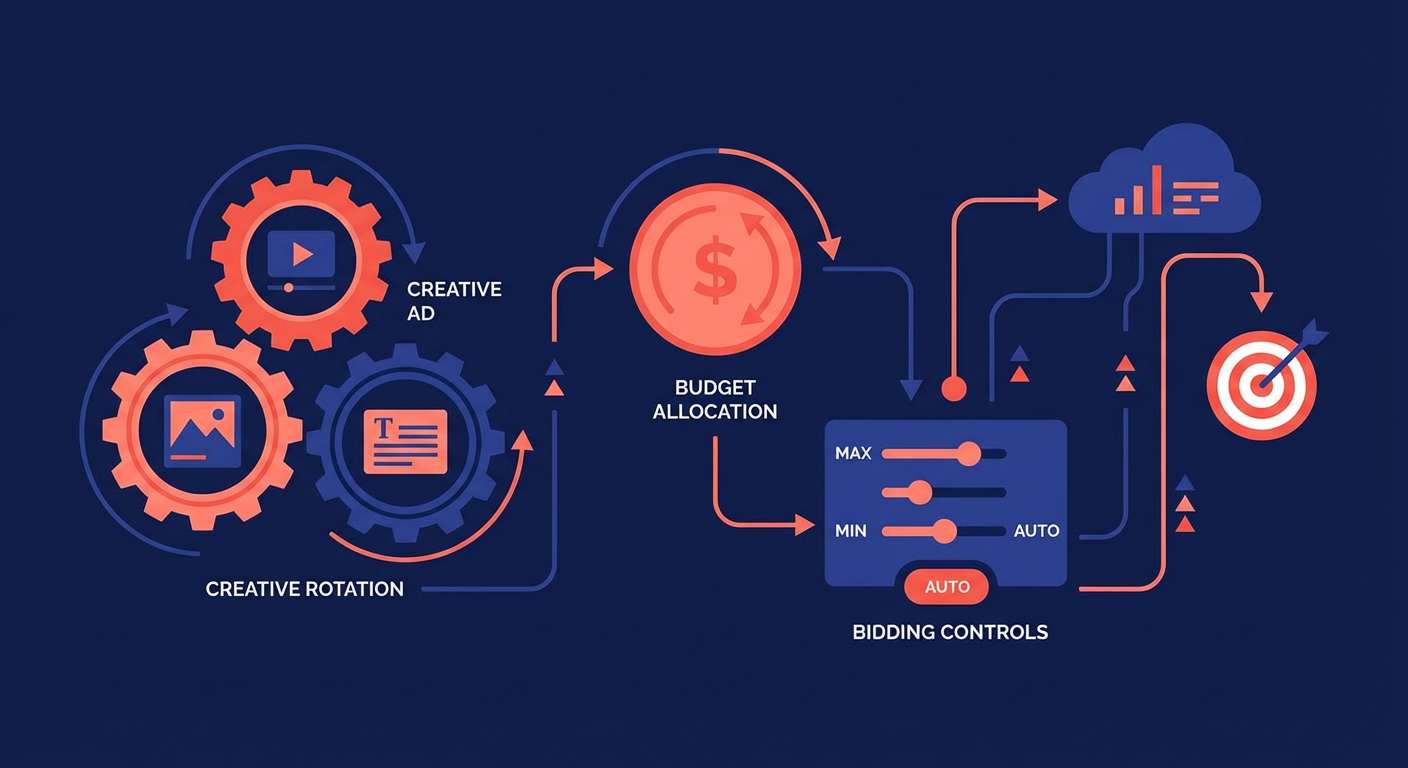
Here's what Smart+ actually does well. Budget allocation across placements is genuinely better automated than manual. TikTok's network now includes the For You feed, search results, TikTok Lite, Pangle (their ad network), and various in-feed positions. Manually splitting budget across these placements is guesswork. Smart+ shifts spend toward whatever's converting in real time. I've seen Smart+ campaigns reallocate 70% of budget to search placements mid-campaign when search started outperforming feed — a move most manual advertisers wouldn't make fast enough.
Creative rotation is the other win. Upload ten creative variants and Smart+ quickly finds the top performers, shifts impressions toward them, and kills underperformers without you touching anything. On TikTok, a winning ad can burn out in five to seven days — sometimes faster — so automated rotation spots the decline before someone checking the dashboard over coffee would.
Where Smart+ falls apart: transparency and control. You can't see which audiences are converting. You can't exclude specific segments. You can't tell the algorithm "stop showing my ads to 14-year-olds" beyond basic age targeting. If your product has a specific buyer persona, Smart+ will happily spend your budget teaching itself who that persona is — at your expense. For brands with clear, narrow audiences, that learning phase burns cash.
The other issue is creative input. Smart+ optimizes what you give it, but it doesn't tell you what to give it. If your ten creative variants are all variations of the same polished product demo, Smart+ will find the best product demo. It won't tell you to try UGC instead. The optimization is within your creative set, not across creative strategies.
Third-Party Ad Management Tools
The middle layer consists of tools that sit between you and TikTok's ad platform. They bolt on rules, workflows, and cross-platform management that TikTok doesn't offer natively.
Revealbot ($99/month and up) is the go-to for rule-based automation. You write conditions like "if CPA exceeds $15 for 24 hours, reduce budget by 20%" or "if CTR drops below 1%, pause the ad." Revealbot executes them without you. This solves the "my CPA spikes at 3 AM when I am asleep" problem. But rules are reactive by nature. By the time the rule fires, the ad has already spent money at an unacceptable CPA.
Smartly (enterprise pricing, usually $2K+/month) goes further. Creative automation, dynamic templates, campaign management across TikTok, Meta, Pinterest, and Snap from one dashboard. If you're spending $50K+ per month across platforms, Smartly starts making sense. You build modular creative templates, plug in your variables (product images, copy variants, CTAs), and it spits out hundreds of ad permutations. Their dynamic video templates are particularly good at producing TikTok creative that doesn't look like it was made by a media buying tool. Steep learning curve though, and the platform basically assumes you have a full paid media team running it.
TikTok Ads Manager bulk features deserve a mention because they're free and underused. Bulk creation lets you upload hundreds of ad variations via spreadsheet. Campaign budget optimization (CBO) automatically distributes budget across ad groups. Automated creative optimization (ACO) lets TikTok remix your assets — headlines, images, videos, CTAs — into combinations. Most advertisers running less than $10K/month can get 80% of what they need from TikTok's own tools before paying for third-party automation.
Here's what all these tools have in common: they automate ad management — bidding, budgeting, rotation. None of them automate ad intelligence — figuring out what competitors are running, why certain hooks land and others don't, what you should test next. That's a completely different problem.
The Intelligence Layer That's Missing
Neither Smart+ nor Revealbot fills this gap. You run TikTok ads. Your competitors run TikTok ads. You are both doing expensive creative experiments. But you can only see your own data.
TikTok's Creative Center shows you top-performing ads by industry — that's useful for creative inspiration. But it won't tell you what your specific competitors pushed live this week, how their creative strategy shifted since last month, or which new hooks they're A/B testing. And it definitely doesn't connect any of that to your own numbers to tell you what to try next.
Rafael, a performance marketer at a mid-size DTC brand, changed his workflow here. He'd been spending about three hours every week scrolling the Creative Center, screenshotting competitor ads, noting patterns, trying to turn all that into creative briefs. His analysis was good. The problem was he couldn't keep it up. After about six weeks, other stuff took over and the competitor tracking died.
He started running a brand mention monitor alongside a PPC competitor analysis agent. The brand monitor catches when competitors mention his brand (or his product category) in their TikTok content — something that happens more often than you'd expect, especially in review-style and comparison content. The PPC agent tracks competitor ad strategy across platforms, including what creative angles they're testing on TikTok.
Together, these give Rafael something his other automation tools do not: strategic context. He can see that Competitor A just shifted from product demos to creator partnerships. Competitor B is testing 60-second ads after months of 15-second clips. A new entrant is running aggressive comparison ads that mention his brand by name. That context directly changes what creative he produces. And on TikTok, creative decisions are the ones that matter most.
When to Automate and When Not To
After two years of running TikTok ads and burning money on most of the automation options out there, here's where I've landed.
Automate: Budget allocation and bid management. This is just math. Computers do math better than we do. Use Smart+, Revealbot rules, or TikTok's CBO. Let automation decide when and how much to spend per placement. The algorithm has more data points than you and reacts faster. Almost always beats manual management.
Automate: Creative rotation and fatigue detection. TikTok creative burns out fast. Let automation shift impressions from declining ads to fresh ones. Do not manually pause ads based on gut feel when the platform can detect performance decline with actual statistics.
Automate: Reporting and performance monitoring. Pulling numbers into a dashboard, flagging anomalies, generating weekly summaries. None of that requires a human. If you're still manually exporting CSVs from TikTok Ads Manager at this point, you're doing it wrong.
Don't automate: Creative strategy. Human judgment still matters most here. What hook to test. Whether to go UGC or polished. Which trends to ride and which to skip. What story to tell. These decisions need cultural context and brand judgment. Automation can tell you which of your ten creatives performed best. It cannot tell you what the eleventh should be.
Don't automate: Audience understanding. Smart+ will find audiences that convert. But figuring out why they convert, what messaging clicks with them, how to expand from your current audience to adjacent segments? That requires someone who actually understands the market.
Don't automate: Competitive response. When a competitor launches an aggressive campaign targeting your keywords or your brand name, you need judgment and speed. Sometimes creativity that does not fit in a rules engine. Monitoring agents help you see what they are doing. Deciding how to respond is on you.
Why Use an Agent for This
Think of the TikTok ads automation stack as three layers. Platform-native tools (Smart+, CBO, ACO) handle execution. Third-party tools (Revealbot, Smartly) add rules and workflows on top. AI agents add intelligence underneath.
The first two layers are well understood. The agent layer is where most advertisers are leaving money on the table. A brand mention monitor catches competitive moves you'd otherwise miss. A PPC competitor analysis agent gives you the strategic context to decide what creative to produce. Neither replaces Smart+ or Revealbot. They inform the decisions you feed into those tools.
Rafael's workflow now: the agent provides competitive intelligence, he makes creative strategy decisions based on that intelligence, and Smart+ handles the execution. Three layers, each doing what it's best at. The agent doesn't manage his bids. Smart+ doesn't tell him what his competitors are doing. And Rafael doesn't spend three hours manually scrolling through the Creative Center anymore.
Let machines handle the execution and the data collection. Keep the creative strategy where it belongs — with someone who actually watches TikTok.
Try These Agents
- TikTok Brand Mention Monitor -- Track when competitors or creators mention your brand on TikTok
- PPC Competitor Analysis -- Spy on competitor ads across Google, Meta, TikTok, LinkedIn, and Reddit
- TikTok Content Research Agent -- Research trending hooks, formats, and content strategy in your niche
- Sentiment Analysis -- Analyze ad comment sentiment and audience reactions