
We Automated Our TikTok Content Research. Our Views Tripled.
Diana runs content for a marketing agency with seven clients who want TikTok content. Every Monday morning, she used to do the same thing: open TikTok, search for each client's category, scroll for an hour per client, screenshot anything interesting, take notes on what hooks were working, and compile her findings into a content brief for the week.
Seven clients at an hour each. Seven hours of scrolling before she could start actually creating anything. And the worst part? Her notes were inconsistent. She'd remember a hook from three weeks ago but couldn't find the original video. She'd notice a format trending up but have no data to prove it beyond "I've been seeing a lot of these." Her instincts were good -- she's been doing this for four years -- but instinct doesn't scale across seven accounts.
Her agency's TikTok content was performing fine. Average views were landing in the expected range for each client's follower count. Nothing was bombing, but nothing was breaking out either. They were consistently mid.
Then she automated the research phase. Within six weeks, average views across all seven accounts had tripled. Not because the production quality changed. Not because they started posting more. Because the content was informed by actual data about what was working right now instead of whatever Diana happened to notice during her Monday morning scroll.
The Content Research Problem on TikTok
TikTok content strategy has a research problem that no other platform shares. On Instagram, you can scroll a competitor's grid and see their entire visual strategy in 30 seconds. On LinkedIn, you can read their posts in minutes. On YouTube, thumbnails and titles tell you most of what you need to know before you click.
On TikTok, the information you need is locked inside the videos themselves. The hook -- the first 1-3 seconds that determines whether someone keeps watching -- can't be evaluated from a thumbnail. The structure of a viral video (how it builds tension, where the payoff lands, what keeps you from swiping away) only reveals itself when you watch the full thing. And the specific language patterns that creators use, the verbal cadences that signal "this is native TikTok content" versus "this is a brand that doesn't get it," require you to listen.
This means content research on TikTok is fundamentally more time-consuming than on any other platform. You can't skim. You have to watch. At 30-60 seconds per video, researching 20 videos per competitor across five competitors takes nearly an hour of pure watch time. And that's before you start analyzing what you saw.
Diana's seven-hour Monday was the honest time investment required to do TikTok content research properly for multiple accounts. She wasn't inefficient. The work genuinely takes that long when you do it manually.
What "Automating Research" Actually Means
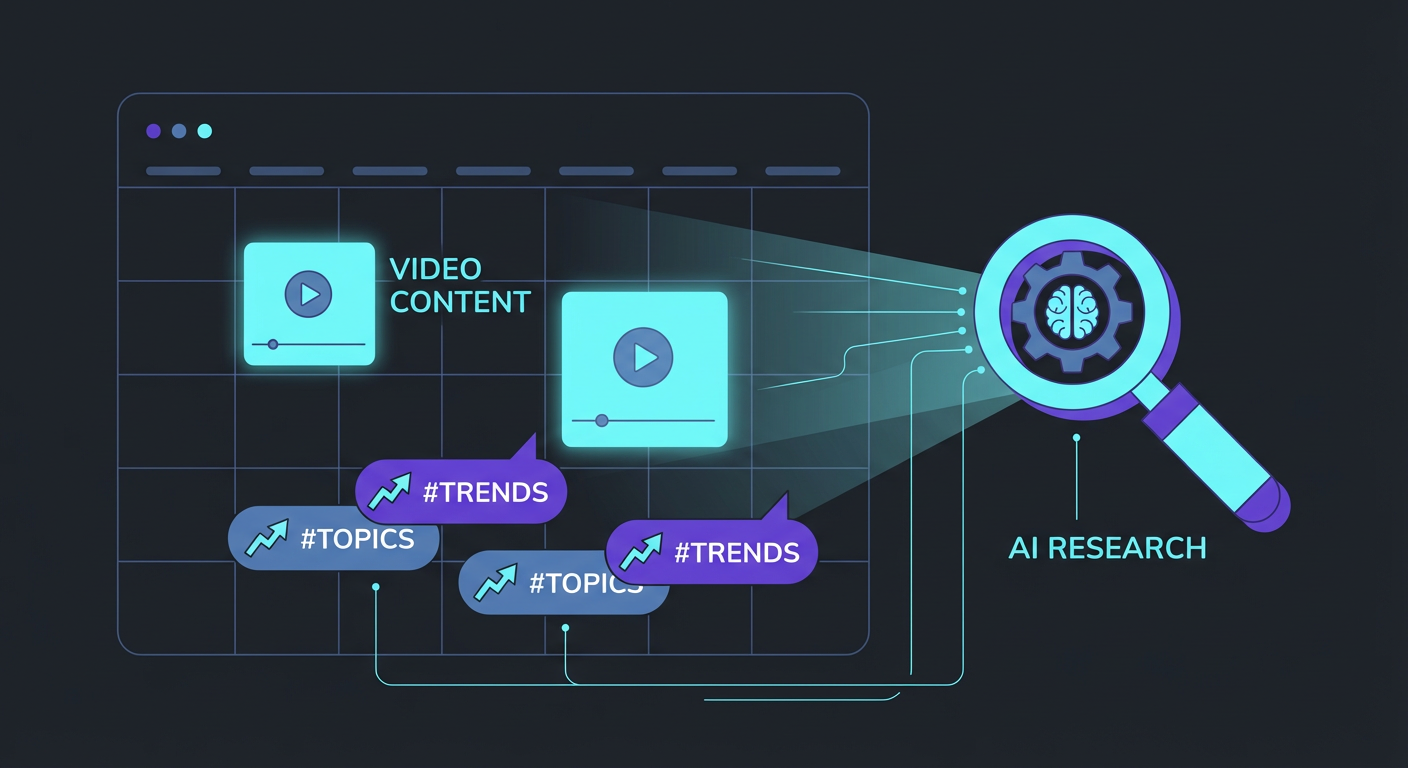
When I say Diana automated her content research, I don't mean she pointed a bot at TikTok and told it to find viral videos. The automation is more specific than that, and understanding what each step does explains why the output is so much better than manual scrolling.
Search and discovery. The agent searches TikTok by keyword for each client's category. "Skincare routine" for the beauty client. "Home office setup" for the furniture client. "Meal prep" for the nutrition client. Each search returns dozens of recent videos ranked by relevance and engagement. Unlike Diana's manual scroll, the agent isn't subject to algorithmic filtering based on her personal watch history. It sees a broader slice of what's performing.
Transcript extraction. This is where it gets powerful. For every video the agent surfaces, it pulls the full transcript -- every word spoken in the video, converted to text. Suddenly, video content becomes analyzable at the same speed as written content. Diana can search transcripts for specific phrases, compare how different creators open their videos, and identify verbal patterns that correlate with high performance.
Hook analysis. The agent categorizes the first line of each transcript into hook types. "Did you know..." is a curiosity hook. "Stop doing this..." is a disruption hook. "I tested every..." is an authority hook. "POV: you just..." is a relatability hook. Across 50 videos in a category, patterns emerge fast. If 35 of the top 50 skincare videos this week open with a disruption hook, that's a data point Diana never had before. And it's a data point that directly translates to a creative decision: lead with disruption this week.
Structure mapping. Beyond the hook, the agent identifies the structure of high-performing videos. How long is the setup? Where does the value delivery happen? Is there a twist or reveal? How do they handle the call to action -- is it verbal, on-screen text, or implied? These structural patterns are the difference between a TikTok that feels native and one that feels like an ad with a vertical crop.
Performance benchmarking. The agent pulls engagement data for every video analyzed -- views, likes, comments, shares. This lets Diana benchmark her clients' content against category averages. If the top 20 skincare videos this week averaged 450K views and her client's best video got 50K, she knows the ceiling is much higher and can study what the top performers are doing differently.
The Transcript Advantage
I want to spend a moment on transcripts specifically, because this is the single capability that changed Diana's workflow the most.
Before automated transcripts, "analyzing" a competitor's TikTok meant watching it and trying to remember what they said. You'd note that a creator had a great hook, but could you reproduce the exact phrasing a week later? Probably not. You'd notice that certain creators had a conversational style that felt effortless, but could you articulate what made it work? Not really.
With transcripts, Diana can do things that were previously impossible:
She can search across 200 video transcripts for specific topics. "How many top creators mentioned retinol this week?" Answer: 14. "How are they framing it -- as a recommendation, a warning, or a controversy?" She can read all 14 transcripts and categorize the framing in minutes.
She can compare hook language across performance tiers. Take the top 10 performing videos and the bottom 10 from the same search. Read the first sentences side by side. The patterns are often obvious when you see them in text. High performers: specific, concrete, make a claim. Low performers: vague, generic, ask a question nobody cares about.
She can identify creator voice patterns that her clients should emulate. Not copy -- emulate. The rhythm, the sentence length, the casual asides. Reading these in transcript form makes the stylistic choices visible in a way that watching the videos doesn't.
She can also spot when a hook or format is being overused. If the same opening line appears in 8 of 50 transcripts, that format is saturated. Audiences will start scrolling past it out of recognition fatigue. Diana knows to avoid it even though manually scrolling TikTok might have suggested it was "trending."
From Research to Content Briefs
Here's what Diana's Monday looks like now.
She runs the agent for each of her seven clients. Each run takes about 10 minutes to return results -- a structured report with top-performing videos, categorized hooks, structural patterns, transcript excerpts, and performance benchmarks.
From those reports, she builds content briefs. Each brief includes:
- Two to three hook options pulled from real high-performing examples (with the transcript excerpts as reference)
- A recommended structure based on what's working this week in that category
- Specific language patterns to use and avoid
- Performance targets based on category benchmarks
- A list of topics that are trending up and topics that are saturated
Her content team now starts the week with seven data-informed briefs instead of seven sets of Diana's notes from memory. The briefs take her about 90 minutes total to compile from the agent reports. Her Monday went from seven hours to under two.
The views tripled because the content stopped being based on "what Diana happened to see" and started being based on "what the data shows is working." Her instincts were good, but they were sampling maybe 5% of the relevant content in each category. The agent samples everything.
Why Use an Agent for This
The TikTok content research agent combines Search Video and Get Transcript to do what Diana spent seven hours doing manually: find what's performing in any TikTok category, analyze why it's performing, and extract actionable patterns for your own content.
The output isn't a list of trending videos. It's an analysis -- hook categories ranked by frequency and performance, structural patterns mapped across top content, language patterns extracted from transcripts, and performance benchmarks you can measure against.
Diana pairs the content research agent with a competitor tracker to monitor specific competitor accounts over time. The content research agent shows what's working across the category broadly. The competitor tracker shows what specific rivals are doing and whether their strategy is changing. Together, they give you the full picture: what works in your space, and what your competitors are doing about it.
For clients who also run TikTok ads, the research agent's findings flow directly into ad creative decisions. The hooks and structures that work organically often translate to paid content, and an agent doing video performance analysis can validate whether that translation is holding up in practice.
Diana's agency didn't hire more people. They didn't subscribe to a trend-tracking platform. They automated the research phase and let humans do what humans are better at: turning insights into creative work.
Try These Agents
- TikTok Content Research Agent -- Analyze trending content, hooks, and formats in any TikTok category using video transcripts
- TikTok Competitor Tracker -- Monitor competitor TikTok accounts for content strategy shifts and posting patterns
- TikTok Video Performance Analyzer -- Benchmark video performance against category averages and track engagement trends
- Brand Monitoring Agent -- Track when creators mention your brand across TikTok and other platforms