
Everyone Wants a Confluence Alternative. We Fixed Confluence Instead.
Marcus sent me a Notion marketing page last October. "Look at this," he said. "Their docs are actually organized. Confluence makes me want to quit." He wasn't alone. Kenji had been lobbying for Slite since the summer. Diana had mentioned Guru in passing. Even Tomás, who normally avoids tool debates, said he'd be open to switching if the migration wasn't painful.
The consensus was clear: Confluence was the problem, and somewhere out there was a better wiki that would solve everything. So I spent two weeks actually evaluating the alternatives. I signed up for trials. I imported our content. I talked to three teams who had made the switch.
What I found was that every alternative had the same fundamental issue Confluence did. The wiki was fine. The people maintaining it were the bottleneck.
The Usual Suspects
Notion is the crowd favorite. Clean interface, flexible page structure, databases embedded in docs. I imported a subset of our engineering space into a Notion trial. It looked better. The pages were easier to read. The sidebar navigation made more sense. Diana liked the toggle blocks and callout formatting.
But within the trial period, I noticed something. The pages I imported were just as stale in Notion as they were in Confluence. A deployment guide that referenced our old CI pipeline was still wrong in Notion. It was just wrong in a prettier font. Moving content from one wiki to another doesn't make the content accurate.
I talked to a team at a company about twice our size that had moved from Confluence to Notion eighteen months earlier. Their engineering lead told me: "We spent three months migrating. The first six months in Notion were great because we rewrote everything during the migration. Then people stopped maintaining it, and now we have the same problem we had in Confluence. Stale pages everywhere. We just have stale pages with better formatting."
Slite markets itself as the "organized" alternative. AI-powered search, automatic organization suggestions, a cleaner interface. Kenji liked that Slite asks you to verify old docs periodically. But periodic verification prompts are just the calendar reminder approach with better UX. When I asked a Slite customer about those prompts, she said: "I clicked 'still accurate' on most of them without actually checking, because I had other work to do."
Guru takes a different approach with verification workflows built into the product. Cards have owners and expiration dates. When a card expires, the owner gets prompted to verify or update it. This is structurally better than Confluence's approach, but it still depends on the owner having time and motivation to do the actual review. The PM at a company using Guru told me their verification rate was about 60%. Four out of ten cards that expired just sat in an "unverified" state because the owner was too busy.
Document360, Tettra, Slab, BookStack. I looked at all of them. Each one has a slightly different take on knowledge management. None of them solve the maintenance problem because the maintenance problem isn't a product feature. It's an operational workflow.
The Real Problem
When I mapped out our actual Confluence complaints, none of them were about Confluence's capabilities as a wiki.
"Pages are outdated." That's a maintenance problem. The wiki doesn't update itself in any tool.
"Search is bad." Confluence search is mediocre, but search quality is directly related to content quality. When half your pages are stale and the naming conventions are inconsistent, no search algorithm will give you good results. I tested our stale content in Notion's search. It returned the same stale pages, just faster.
"Navigation is confusing." Our space structure had grown organically over three years. Spaces were created for projects that ended. Pages were nested six levels deep. This is an organizational problem. It would follow us to any new tool unless we spent weeks restructuring during migration, and then it would re-emerge as soon as people started creating pages without a plan.
"Nobody knows where to find things." A direct consequence of stale content, bad navigation, and search returning unreliable results. Fix the content, fix the structure, and findability improves regardless of the tool.
Priya put it plainly: "We're blaming Confluence for our own neglect. We wouldn't water our plants for a year and then blame the pot."
Fixing the Content Layer
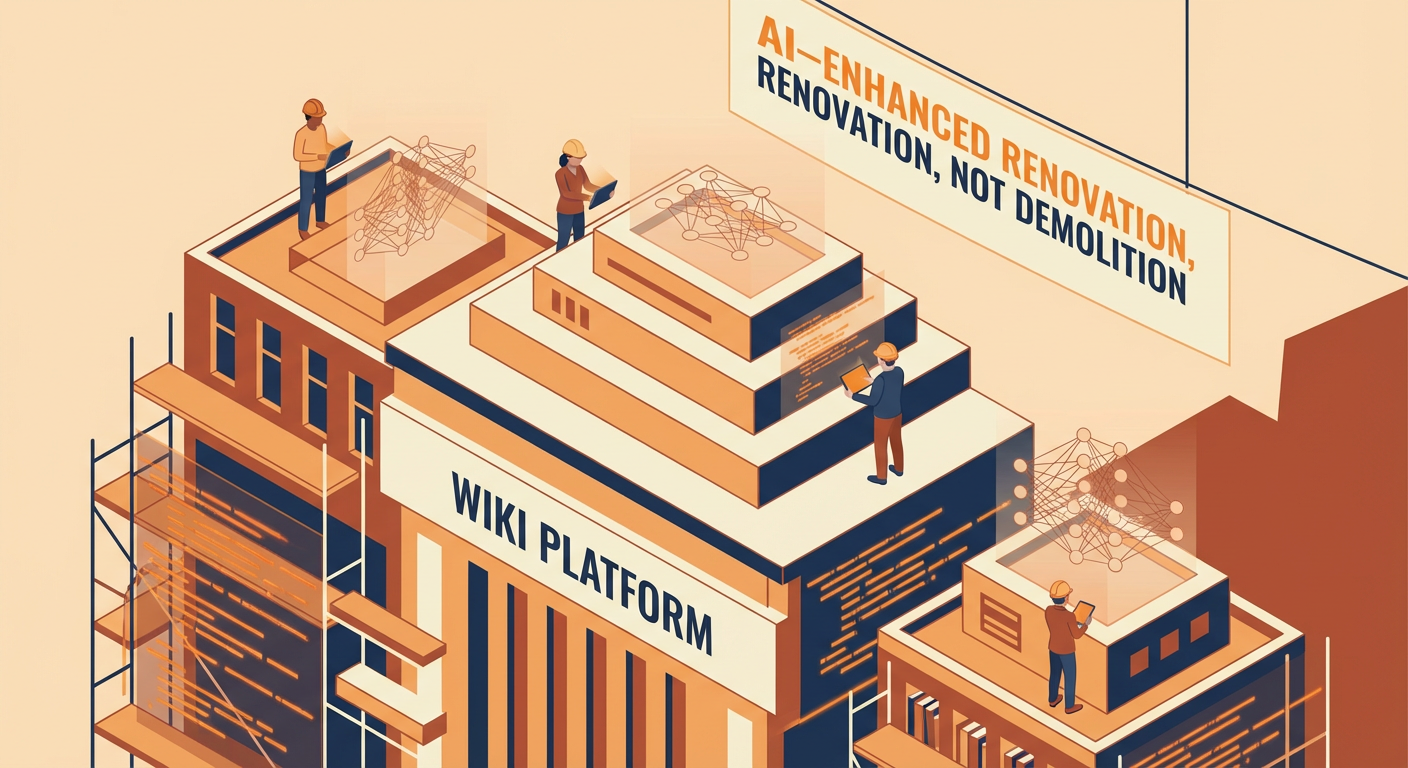
Instead of migrating to a new tool and hoping our habits would change (they wouldn't), we kept Confluence and added an AI agent layer to handle the maintenance work nobody was doing.
The documentation updater runs continuously. It monitors our Confluence spaces for pages that have drifted out of sync with reality. When code changes affect documented processes, the agent identifies the relevant Confluence pages and either makes the update directly or flags it for review. When it detects broken links, outdated screenshots, or references to tools we no longer use, it generates a fix and routes it to the page's author for approval.
This replaced the quarterly review process that nobody was doing. Instead of asking humans to remember to check their pages every 90 days, the agent checks everything continuously and surfaces only the pages that actually need attention.
The effect was immediate. In the first month, the agent identified and updated 28 pages that referenced our old deployment pipeline. It found 14 broken links to internal tools that had moved to new URLs. It flagged 6 pages that contradicted each other about the same process. Elena spent about four hours that month reviewing and approving the agent's suggestions. That four hours replaced what would have been a full-team effort of 30+ hours to manually review every page.
We also deployed agents for meeting notes and onboarding content. Meeting notes get published automatically. The onboarding guide generator keeps our onboarding space current by cross-referencing setup instructions against the actual tools and repos new hires need access to.
What We Gained Without Migrating
Three years of accumulated content stayed intact. Every page, every comment, every attachment. We didn't lose the tribal knowledge embedded in old pages. We didn't break the bookmarks people had saved. We didn't invalidate the links shared in hundreds of Slack messages and email threads over three years.
The team didn't have to learn a new tool. Marcus didn't have to figure out where Notion puts things. Diana didn't have to rebuild her page templates. Tomás didn't have to relearn keyboard shortcuts. The cognitive cost of switching tools for an entire team is hard to quantify, but it's real.
Our Jira integration kept working. Our Confluence-to-Slack notifications kept working. The macros people had set up in pages kept working. Migration means rebuilding every integration, and we have about a dozen that touch Confluence in some way.
And the problems actually got solved. Stale content is now caught within days, not months. Meeting notes exist for every meeting, not just the ones where someone remembered. Onboarding docs stay accurate because the agent verifies them against live systems, not because a human remembered to check.
When You Should Actually Switch
I'm not arguing that Confluence is the best wiki for everyone. There are legitimate reasons to move.
If you're a small team under fifteen people and Confluence feels heavy, Notion or Slite will feel lighter. The overhead of spaces, permissions, and admin settings in Confluence is designed for larger organizations. Small teams don't need it.
If you're already deep in the Notion ecosystem for project management and task tracking, having your docs in Notion too reduces context switching. The value of a unified workspace is real if you're actually using the other parts of the platform.
If cost is the primary issue, Confluence's pricing for large teams can be steep. Open-source alternatives like BookStack or Wiki.js eliminate the per-user cost, though they come with self-hosting complexity.
But if your complaint is "our pages are stale," "nobody updates anything," or "I can't find what I need," those complaints will follow you to the next tool. I've confirmed this with teams that switched to Notion, Guru, and Slite. The first few months feel great because migration forces a content rewrite. Then the maintenance drops off, and within a year, the new tool has the same problems the old one did.
Eight Months Later
Our Confluence instance has 398 pages now, down from 431 when we started. The agent identified 33 pages that were fully obsolete, either duplicates, pages for completed projects, or docs that described deprecated systems. We archived them.
Of the remaining 398 pages, the agent's weekly audit shows 94% have been verified or updated within the last 90 days. Before the agent, that number was under 40%.
Marcus doesn't send me links to Notion marketing pages anymore. Last week he told me: "I actually found what I was looking for in Confluence on the first try. That hasn't happened in two years." Kenji dropped the Slite campaign. Diana uses Confluence daily without complaining about it, which from Diana is high praise.
The search got better too, without changing the search engine at all. When pages are accurate and consistently maintained, the existing search returns useful results. Turns out Confluence search wasn't broken. It was just faithfully surfacing the broken content we'd given it.
We spent zero days on migration. Zero hours retraining the team. Zero integrations rebuilt. The agent layer took about two days to set up and runs continuously without intervention. The total cost was less than what a single week of a three-month migration would have consumed.
If you're evaluating Confluence alternatives right now, run one experiment first. Take your most-used space and have someone spend a day bringing every page up to date. Then see if the tool still feels broken. The question is whether you maintain that quality with humans who have other jobs, or with agents that don't.
Try These Agents
- Confluence Documentation Updater -- Keep pages in sync with code changes and process updates automatically
- Confluence Knowledge Base Auditor -- Weekly scans for broken links, stale content, and contradictions across spaces
- Confluence Onboarding Guide Generator -- Keep onboarding docs accurate by cross-referencing against live systems and tools